3.1.14
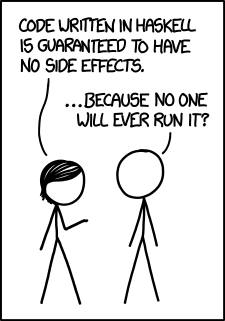
Haskell in XKCD


Scots have nothing to lose going the ‘indy’ route

Iain Robertson presents a concise summary of the argument for Scottish independence. From The Japan Times of all places, and March 2013 of all times.
Under the current devolved settlement, Scotland has a parliament sitting in Holyrood, Edinburgh, which controls a paltry 16 percent of the country’s tax base. The game-changing economic and social policy levers remain in the hands of the U.K. government, leaving Scotland unable to properly tackle some of its social ills or take full advantage of its many natural resources.
Scotland’s union with England and the other parts of the U.K. is not offering Scots the best option. The current political landscape across the nations of the U.K. is one where Westminster is controlled by a Conservative-Liberal coalition government that was roundly rejected by Scottish voters at the last election; just one Conservative member of Parliament hails from a seat north of the border.
...
Recent figures revealed in “The Government Expenditure and Revenue Scotland 2011-12 Report” show that, rather than enjoying handouts, Scotland is paying more money in tax than it receives in U.K. public spending, to the tune of around £863 per head of its population.
Newspapers the length and breadth of the U.K. continue to run baseless front-page scare stories about independence. What many of these failing newspapers make clear is that the so-called “union” of countries is viewed by London as being one they control.
There is even more to Scotland’s economic potential as an independent country than its booming oil and renewable energy industries. It has a number of world- class business sectors; including food and drink, life sciences and a first-class education system. Scotland has much to offer — both to itself and the world.
...
There is even more to Scotland’s economic potential as an independent country than its booming oil and renewable energy industries. It has a number of world- class business sectors; including food and drink, life sciences and a first-class education system. Scotland has much to offer — both to itself and the world.
...
As Scots singer Eddie Reader retweeted: “indy (independence) gives us uncertainty with power, U.K. gives uncertainty without power.”
23.12.13
American Studies Association joins academic boycott of Israel

22.12.13
Fear, Uncertainty, Doubt, and Scotland

From The Jargon File:
FUD: /fuhd/, n.Much FUD has been slung by the opponents of independence.
Defined by Gene Amdahl after he left IBM to found his own company: “FUD is the fear, uncertainty, and doubt that IBM sales people instill in the minds of potential customers who might be considering [Amdahl] products.” The idea, of course, was to persuade them to go with safe IBM gear rather than with competitors' equipment. This implicit coercion was traditionally accomplished by promising that Good Things would happen to people who stuck with IBM, but Dark Shadows loomed over the future of competitors' equipment or software. After 1990 the term FUD was associated increasingly frequently with Microsoft, and has become generalized to refer to any kind of disinformation used as a competitive weapon.
The opening salvo was Jose Manuel Barroso's announcement, in December 2012, that an independent Scotland could not presume admission to the EU. Really? As Scottish Deputy First Minister Nicola Sturgeon said, “No serious person can argue that it is anything other than in the interests of the EU to keep Scotland in continuous membership”. Barroso's statement was pure FUD (or bunkum), prompted by Cameron and by Spain's concern that Scottish independence might strengthen Basque aspirations.
Another example is when George Osborne and Danny Alexander reiterated, in April and November 2013, that Scotland could not rely on England agreeing to a currency union. Really? Yet even Alisdair Darling, head of Better Together, had aleady admitted in January 2013 that “Of course, it would be desirable to have a currency union... If you have independence, or separation, of course a currency union is logical.” Alexander's and Osborne's statements don't go so far as to rule out monetary union; their purpose is to trowel FUD over the future of Scotland.
And when the SNP released its White Paper this month, it was another occasion for opponents to cast aspersions. Danny Alexander immediately claimed a £1.6 billion gap in funding. Really? Finance Secretary John Swinney responded “The No campaign's numbers are all over the place. If we go back to September, they were alleging a £32bn black hole in the finances of an independent Scotland. That came down in November to £10bn and we have now got a claim of £1.6bn. When you look at the Treasury analysis there is no account taken of the positive impact on the economy of any of the measures we have set out to boost growth within the Scottish economy.” Critics of the White Paper need not engage seriously with its premises. Spreading FUD is more effective.
Which is not to say that the future is certain. Any large change such as independence of necessity makes the future harder to predict. But we can see some consequences of independence clearly. We will avoid the £25bn cost of Trident. We will maintain free tuition for students, free prescriptions under the NHS, and free nursing for the elderly, benefits Scots enjoy and the English are denied, and which without independence we will face pressure to revoke. We will be free to maneuver in an uncertain future based on the vision of the Scots rather than the conservatism of the Tories.
Let's examine our choices clearly, and recognise FUD for what it is: the way the Powers That Be, whether IBM, Microsoft, or the UK Government, seek to keep others from considering better alternatives.
30.11.13
.JPG)
28.11.13
Students support strike

Will Hutton, writing in the Guardian, described the situation succinctly:
The real wages of academics have fallen by 13% since 2008, one of the largest sustained wage cuts any profession has suffered since the Second World War.University administrators offer 1% and refuse to negotiate. Faculty struck on 31 October and a second strike is called for 3 December. As usual, our students put the case more eloquently than our union (the UCU, University and College Union). The leadership of EUSA (Edinburgh University Student Association) write:
Tensions are high within the University, as the second day of strike action draws nearer and many continue to work to rule. At such times we may hear the oft-quoted: “For the sake of students, don’t go on strike!”The photo above shows me picketing the Informatics Forum, surrounded by students during a previous strike in 2011.
We write on behalf of EUSA and our 32,000 members, to actively encourage you to take strike action. In the short term this will indeed affect our education, but the long term benefits are significantly vaster.
It is critical that students and staff struggle collectively. Not only to ensure that the sector continues to attract the highest calibre of people, but also so staff are able to focus on the job – not worrying about the rocketing cost of living. Needless to say, colleagues at the start of their career are hardest hit, including the thousands of EUSA’s postgraduate members who help teach.
The demands are reasonable, and the more effective the action now the sooner we can get back to the reason we’re all here – education.
It is for this reason that EUSA’s academic reps, who aren’t exactly our most radical bunch, have voted overwhelmingly in favour of actively supporting the on-going strike action. This decision has been met with broad approval from across the student body. Dozens of our reps and countless other students were out on the picket lines at 7am the other week, and have vowed to be there next time.We are actively encouraging our members not to cross the picket lines and to study from home.Education continues to be progressively marketised, fees continue to rise, power continues to shift away from ordinary staff and into the hands of the overpaid in Old College. At times like these it is vital that the university acts as a community and reasserts its stake over the corporate body. We do this by working together, and recognising that our struggles are in common.
So again, we implore you, on behalf of your students, not to undermine the strike. And hopefully we'll be seeing you on the picket lines!
In solidarity,Hugh, Nadia, Alex and KirstyThe EUSA Sabbatical Team
26.11.13
Amdahl's law for predicting the future of multicores considered harmful

Amdahl's law for predicting the future of multicores considered harmful
B.H.H. Juurlink , C. H. Meenderinck, ACM SIGARCH Computer Architecture News, Volume 40 Issue 2, May 2012, Pages 1-9.
Several recent works predict the future of multicore systems or identify scalability bottlenecks based on Amdahl's law. Amdahl's law implicitly assumes, however, that the problem size stays constant, but in most cases more cores are used to solve larger and more complex problems. There is a related law known as Gustafson's law which assumes that runtime, not the problem size, is constant. In other words, it is assumed that the runtime on p cores is the same as the runtime on 1 core and that the parallel part of an application scales linearly with the number of cores. We apply Gustafson's law to symmetric, asymmetric, and dynamic multicores and show that this leads to fundamentally different results than when Amdahl's law is applied. We also generalize Amdahl's and Gustafson's law and study how this quantitatively effects the dimensioning of future multicore systems.
20.11.13
PhD Studentship on ABCD

We are recruiting for one PhD student to work on design and implementation of programming languages. The post is on the project "From Data Types to Session Types: A Basis for Concurrency and Distribution".http://homepages.inf.ed.ac.uk/wadler/abcd-phd-advert.html
The project has particular emphasis on putting theory into practice, embedding session types in a range of programming languages and applying them to realistic case studies. The research programme is joint between the University of Edinburgh, University of Glasgow, and Imperial College London, and includes collaboration with Amazon, Cognizant, Red Hat, VMware, and the Ocean Observatories Initiative. We have a programme grant funded by EPSRC for five years from 20 May 2013.
The successful candidate will join a team responsible for extending the functional web programming language Links with session types to support concurrency and distribution. We will test our techniques by providing a library to access Amazon Web Services (AWS) cloud computing infrastructure, and perform empirical experiments to assess how our language design impacts the performance of programmers.
You should possess an undergraduate degree in a relevant area, or being nearing completion of same, or have comparable experience. You should have evidence of ability to undertake research and communicate well. You should have a background in programming languages, including type systems, and programming and software engineering skills.
It is desirable for candidates to also have one or more of the following: a combination of theoretical and practical skills; experience of web programming or cloud programming; knowledge of the theory or practice of concurrent and distributed systems; knowledge of linear logic; or training in empirical measurement of programming tasks. We especially welcome applications from women and minorities.
We seek applicants at an international level of excellence. The School of Informatics at Edinburgh is among the strongest in the world, and Edinburgh is known as a cultural centre providing a high quality of life.
The successful candidate will receive a studentship covering tuition and subsistence. Students from the UK or EU are preferred, but studentships may be available for overseas students with strong qualifications. Applications should be received by 13 December to be eligible for the full range of scholarships. Consult the University of Edinburgh website for details of how to apply.
Enquiries can be addressed to: Prof. Philip Wadler (wadler@inf.ed.ac.uk), Principal Investigator of the ABCD project.
17.11.13
The Monad Tutorial Fallacy

16.11.13
Economics of Scottish Independence

Would Scotland be better off or worse off under independence? I've often been told that England subsidises Scotland, that Scotland already gets "more than its fair share", and that independence would bring that to an end. Is it true? Before buying independence, I'd better perform due diligence.
I'm in favour of independence, so I wanted to examine the figures provided by someone against.
I found this report by Brian Ashcroft, an emeritus professor of economics from Strathclyde, who argues Scots would be better off remaining with the English. (His collected posts on independence are here.) Examining his argument for dependence leads me to the conclusion that independence is essential.
The graph above, taken from Ashcroft's report, shows that in recent years, Scottish spending has exceeded Scottish revenues (including from oil). Uh oh! However, he mentions briefly, and a web search confirms (see graph below, from The Guardian) that UK spending has exceeded revenue by a far larger amount.
I think this shows that Scotland is in better shape for independence than the UK as a whole, because we would have less debt, assuming it was fairly allocated. Ashcroft argues that Scotland has gotten back what it contributed in oil revenue, so that everything is hunky dory, but that doesn't ring true if one considers that over the same period the UK margin of spending over revenue was far greater than Scotland's.
Ashcroft's most significant point, in my view, is that going forward Scotland may have to pay a higher rate for borrowing than the UK, but if the Scottish economy is better managed for growth than the UK, then this would pale into insignificance.
As the graphs show, we have a problem: but it is a smaller problem than the UK as a whole, and we have a better chance to solve it on our own. Better together? I don't think so.
Subscribe to:
Posts (Atom)