26.8.10

L'Illusionniste


L'Illusionniste, Sylvain Chomet's second film and Jacques Tati's last, is a remarkable film; The Guardian gave if five stars. The film also reflects a tortured family history. Among other things, it is a love letter to Edinburgh, with loving depictions of many familiar locations. I saw it in the Cameo; how often do you watch a film that includes a scene in the very place you are sitting? While many of the settings are easy to identify, I could not place one key location, the 'Royal Music Hall' (see below)---did this actually exist in Edinburgh, and if so, where?

The Economics of Programming Languages


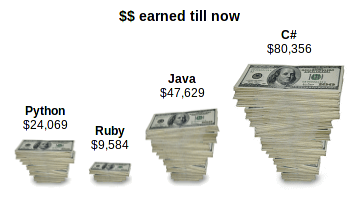
Network effects are clearly significant in the spread of programming lagnuages. I've often thought it would be good to team up with an economist to see if one could say something more forceful than just that simple qualitative observation. Meanwhile, I'm pleased to find the web page linked to above, which covers at least the obvious correspondences. (NB., the picture is from a different page.)

Programming Language Popularity


A site that tracks popularity of Programming Languages. Many of my favorite languages appear on the list. Interesting to see that (for this week at least) the order is Scheme, Haskell, Smalltalk, Erlang, Scala, O'Caml.

24.8.10

Sights and sounds of sorting


Nifty visualisation with sound of several sorting algorithms. It covers insert, bubble, selection, merge, and gnome sort; a related video tackles heap sort. Could be useful for teaching. Below is a second visualisation with robots.

11.8.10

Masterminds of Programming wins JOLT award

Masterminds of Programming, edited by Federico Biancuzzi and Shane Warden, has just won a Jolt award. The book features interviews with the creators of many programming languages, including a chapter on Haskell with contributions from Paul Hudak, John Hughes, Simon Peyton Jones, and myself.

3.8.10

The Bull, the Bear, and the Python (Part 2)

A previous post described the SEC's plan to clarify certain kinds of trades by describing them using a computer program, written in Python. Responses to the SEC's request for comments are now online, including a response jointly submitted by USACM and SIGPLAN. My thanks to all the experts who volunteered to help us formulate a response and ensure it represented the views of the USACM and SIGPLAN membership.

1.7.10

Visualization of Natural Deduction as a Game of Dominoes


The usual Gentzen-style rules make some use of visual layout, but I suspect it may be possible to exploit the potential of graphical techniques far more effectively. Here is one attempt to do so. I'm not entirely convinced by this particular approach, but it is a brave attempt and worth noting.

29.6.10

Information is Beautiful: How Will The Budget Impact the Deficit?


A stunning Infographic from David McCandless of Information is Beautiful. Note the £1 billion raise in capital gains compared to the £13 billion raise to VAT. An interesting perspective on these comments is offered by Joseph Stiglitz. Spotted via Boing Boing.

24.6.10

Why Undergraduates Should Learn the Principles of Programming Languages


SIGPLAN's Education Board has produced a document describing why undergraduate education in programming languages is essential. It's aimed at academics who are not specialists in programming languages. Please read and comment to help SIGPLAN improve it!