23.9.10

Science is Vital


My colleague, Maria Wolters, writes:
I'd also like to mention the Science is Vital campaign, which is orchestrated by biomedical researchers but aims to be as inclusive as possible. There will be a march in London on October 7, a letter writing campaign, and potentially much more ... I know it's incredibly tempting not to do anything because politicians don't listen anyway, but if we don't complain loudly enough now, we might as well stick a sign on our backs saying "Doormats - If You Need Funds, Take Them From Us."

Portsmouth Sinfonia


A colleague recently referred to EPSRC's approach of appointing program managers untrained in the areas they manage as like the Portsmouth Sinfonia.

22.9.10

Twelve Virtues of Rationality

"These then are twelve virtues of rationality: Curiosity, relinquishment, lightness, evenness, argument, empiricism, simplicity, humility, perfectionism, precision, scholarship, and the void." By Eliezer S. Yudkowsky. Spotted via Conal Elliott. Thanks for the tip, Conal, it's a great read.

10.9.10

ed lambda Meetup

For those of you in or near Edinburgh: 7pm Monday 13 September 2010, Malone's Irish Bar, 14 Forrest Road. How to find us: "Look out for the lambda on the table". Organized by Ollie Saunders.

30.8.10

What Sequential Games, the Tychonoff Theorem and the Double-Negation Shift have in Common

Cantor Set by Kevin van Aelst
A recent paper by Escardo and Oliva, to appear in MSFP 2010, relates diverse aspects of computing, in the form of a literate Haskell program. I've written a further note inspired by theirs, also as a literate Haskell program. My code improves on theirs in a few ways, notably by using type classes to characterize valuation types, and by using QuickCheck to describe and check relevant properties. My note can be read stand-alone, but is best read in conjunction with Escardo and Oliva's paper. (The photo above is Cantor Set by Kevin van Aelst.)

Does Your Language Shape How You Think?


From an article in the New York Times by Guy Deutscher, describing linguistics view of the Sapir-Whorf hypothesis, seventy years on. Taken from his book Through the Language Glass: Why the World Looks Different in Other Languages. Spotted on Lambda the Ultimate.
For instance, some languages, like Matses in Peru, oblige their speakers, like the finickiest of lawyers, to specify exactly how they came to know about the facts they are reporting. You cannot simply say, as in English, “An animal passed here.” You have to specify, using a different verbal form, whether this was directly experienced (you saw the animal passing), inferred (you saw footprints), conjectured (animals generally pass there that time of day), hearsay or such. If a statement is reported with the incorrect “evidentiality,” it is considered a lie. So if, for instance, you ask a Matses man how many wives he has, unless he can actually see his wives at that very moment, he would have to answer in the past tense and would say something like “There were two last time I checked.” After all, given that the wives are not present, he cannot be absolutely certain that one of them hasn’t died or run off with another man since he last saw them, even if this was only five minutes ago. So he cannot report it as a certain fact in the present tense.
I wish all scientists were trained in this language!

26.8.10

L'Illusionniste


L'Illusionniste, Sylvain Chomet's second film and Jacques Tati's last, is a remarkable film; The Guardian gave if five stars. The film also reflects a tortured family history. Among other things, it is a love letter to Edinburgh, with loving depictions of many familiar locations. I saw it in the Cameo; how often do you watch a film that includes a scene in the very place you are sitting? While many of the settings are easy to identify, I could not place one key location, the 'Royal Music Hall' (see below)---did this actually exist in Edinburgh, and if so, where?

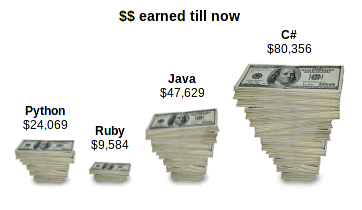
The Economics of Programming Languages


Network effects are clearly significant in the spread of programming lagnuages. I've often thought it would be good to team up with an economist to see if one could say something more forceful than just that simple qualitative observation. Meanwhile, I'm pleased to find the web page linked to above, which covers at least the obvious correspondences. (NB., the picture is from a different page.)

Programming Language Popularity


A site that tracks popularity of Programming Languages. Many of my favorite languages appear on the list. Interesting to see that (for this week at least) the order is Scheme, Haskell, Smalltalk, Erlang, Scala, O'Caml.

24.8.10

Sights and sounds of sorting


Nifty visualisation with sound of several sorting algorithms. It covers insert, bubble, selection, merge, and gnome sort; a related video tackles heap sort. Could be useful for teaching. Below is a second visualisation with robots.