Showing posts with label Science. Show all posts

25.8.26

The Gargantuan Lie That is Collapsing the World's Climate


Adam McKay, director of Don't Look Up, points out what should be obvious but is easy to ignore.

Like all grand lies, “we have more time” takes many different forms, often focus-grouped. There are the lofty-sounding promises to reach “Net-zero emissions by 2050,” as if 24 years from now was soon enough. There are the queries of “What’s your carbon footprint?,” as if individual people with plastic bags or straws were the problem and not gigantic multinational corporations. There’s the accusation that anyone who expresses urgency is a “doomer.” There are those who treat climate as an abstraction to win political campaigns, first arguing that the Biden administration’s Inflation Reduction Act was a victory despite doing nowhere near enough to address the scale of climate collapse, and more recently that Democrats should just stop talking about climate and focus on more “winnable” issues. Most damaging and common of all, there are those who simply don’t mention it.

All of these distortions have robbed us of the most critical element people need to understand a threat and adjust their actions accordingly: context.

And make no mistake, when it comes to how much time we have, the data and the geological record are crystal clear. 

For some badly-needed context, the last three years, likely for the first time in over 100,000 years, have averaged above the Paris Accords’ “do not cross” 1.5 degrees celsius planetary warming. Only ten years ago, that was considered catastrophic, but now mainstream news tells us it’s just a number.

...

Let’s do the context thing again: 2C will mean we have completely left the stable climate period known as the Holocene. This is the 11,000-year-old era that has given us large-scale crop and livestock agriculture, which gave us cities, written language, modern science and medicine, and warm beds and showers.

Before that, for hundreds of thousands of years in the Pleistocene era, humans (and our hominid ancestors) spent most of their time running from drought, fires, floods, extreme cold and heat, predators, and each other. 

The population was likely no more than a few million people spread across the whole planet. At one point we may have almost gone extinct, with just 10,000 Homo sapiens clinging to life. But after the advent of the Holocene and its remarkably stable climate, in only 100 centuries the world population has risen to 8 billion.

That is what we stand to lose. In fact, if our institutions, news and elected officials continue to feed and water the oil company-conceived mega-falsehood that climate breakdown is something just “our great-grandkids need to worry about,”  human civilization as we know it will collapse and billions could die. And we’re not talking about the far distant future. We are talking about collapse within years, not centuries. For real.

9.9.25

Translation Table


I remember seeing a version of the above in High School. My favourite entries, which I quote to this day, are

"... accidentally strained during mounting" --> "... dropped on the floor"

"... handled with extreme care throughout the experiments" --> "... not dropped on the floor"

and

"correct within an order of magnitude" --> "wrong"

From Futility Closet. Spotted via Boing Boing.

21.8.25

Why are we funding this?


In the face of swinging funding cuts in the US, David Samuel Shiffman defends the value of scientific curiosity in American Scientist. Spotted via Boing Boing.

15.12.22

The Rise and Fall of Peer Review


A fascinating blog post by Adam Mastroianni, suggesting that peer review is a failed experiment.

From antiquity to modernity, scientists wrote letters and circulated monographs, and the main barriers stopping them from communicating their findings were the cost of paper, postage, or a printing press, or on rare occasions, the cost of a visit from the Catholic Church. Scientific journals appeared in the 1600s, but they operated more like magazines or newsletters, and their processes of picking articles ranged from “we print whatever we get” to “the editor asks his friend what he thinks” to “the whole society votes.” Sometimes journals couldn’t get enough papers to publish, so editors had to go around begging their friends to submit manuscripts, or fill the space themselves. Scientific publishing remained a hodgepodge for centuries.

(Only one of Einstein’s papers was ever peer-reviewed, by the way, and he was so surprised and upset that he published his paper in a different journal instead.)

That all changed after World War II. Governments poured funding into research, and they convened “peer reviewers” to ensure they weren’t wasting their money on foolish proposals. That funding turned into a deluge of papers, and journals that previously struggled to fill their pages now struggled to pick which articles to print. Reviewing papers before publication, which was “quite rare” until the 1960s, became much more common. Then it became universal.

Now pretty much every journal uses outside experts to vet papers, and papers that don’t please reviewers get rejected. You can still write to your friends about your findings, but hiring committees and grant agencies act as if the only science that exists is the stuff published in peer-reviewed journals. This is the grand experiment we’ve been running for six decades.

The results are in. It failed.

Thanks to Scott Delman for the pointer.

The post also cites a scientific paper by Mastroianni that he published direct to his blog, circumventing peer review while allowing him to write in a far more readable style. It's a great read, and you can find it here: Things Could be Better.

10.1.22

Gödel, Animated


A five-minute primer on Gödel and incompleteness, courtesy of Marcus du Sautoy and TED-Ed. While not named, the fellow in the hat disgruntled by the discovery is clearly Hilbert.

5.1.22

Beyond the Scope


Researchers tend to focus on research, ignoring relevant politics. But of course we should pay attention to the context of our work. Here is a comic on that subject, by Max Easton and Lizzie Nagy. Spotted in The Nib.

29.7.21

Time to say goodbye to our heroes?

Lindy Elkins-Tanton describes and disputes the "hero" model of academia, and suggests a model instead organised around teams focused on big questions. Thanks to Jan de Muijnck-Hughes for the pointer.
Reorienting our focus from the hero model’s “big people” to the consideration of big questions will address many of the challenges plaguing universities today: incremental, derivative, low-risk science; faltering funding; relentless focus on quantity of publication; irreproducible research; ongoing complaints of harassment; lack of diversity; an atmosphere that leaves students struggling with mental health; and (despite enormous funding outlays) an inadequately trained workforce in the STEM fields of science, technology, engineering, and math.

27.2.21

Reverse Engineering the source code of the BioNTech/Pfizer SARS-CoV-2 Vaccine


Entrepreneur and software developer Bert Hubert explains the structure of the vaccine, with plentiful analogies to computing. There are some amazing hacks in there! Thanks to Lennart Augustsson for the pointer.

Welcome! In this post, we’ll be taking a character-by-character look at the source code of the BioNTech/Pfizer SARS-CoV-2 mRNA vaccine.

Now, these words may be somewhat jarring - the vaccine is a liquid that gets injected in your arm. How can we talk about source code?

This is a good question, so let’s start off with a small part of the very source code of the BioNTech/Pfizer vaccine, also known as BNT162b2, also known as Tozinameran also known as Comirnaty.

14.10.19

The Next 7000 Programming Languages


The Next 7000 Programming Languages, by Chatley, Donaldson, and Mycroft, appears in a book marking 10,000 volumes of LNCS. Though they riff on Landin's title, the authors consider something quite different: Darwinian evolution in the context of programming languages. I've long thought we need a theory of the economics of programming languages, to explain why the most popular language is not always that one might consider best suited to a task. But, until now, it's not been clear to me what such a theory might consist of, other than the observation that network effects apply to programming languages. This paper points in the direction of a theory of programming languages as a whole, drawing on evolutionary theory and with a potential grounding in empirical measures, such as scraping Github to measure which languages are more or less popular.

It is useful here to distinguish between the success of a species of plant (or a programming language) and that of a gene (or programming language concept). For example, while pure functional languages such as Haskell have been successful in certain programming niches the idea (gene) of passing side-effect-free functions to map, reduce, and similar operators for data processing, has recently been acquired by many mainstream programming languages and systems; we later ascribe this partly to the emergence of multi-core processors.

This last example highlights perhaps the most pervasive form of competition for niches (and for languages, or plants, to evolve in response): climate change. Ecologically, an area becoming warmer or drier might enable previously non-competitive species to get a foothold. Similarly, even though a given programming task has not changed, we can see changes in available hardware and infrastructure as a form of climate change—what might be a great language for solving a programming problem on a single-core processor may be much less suitable for multi-core processors or data-centre solutions.

Amusingly, other factors which encourage language adoption (e.g. libraries, tools, etc.) have a plant analogy as symbiotes—porting (or creating) a wide variety of libraries for a language enhances its prospects.

10.12.16

Do you have Q?


A study conducted at Northeastern analyses the factors that contribute to success in science. Age is not one of them.
The research team began by focusing on career physicists. It ransacked the literature going back to 1893, identifying 2,856 physicists with careers of 20 years or more who published at least one paper every five years — widely cited findings rated as “impact” papers — and the team analyzed when in a career those emerged. ...
[K]eeping productivity equal, the scientists were as likely to score a hit at age 50 as at age 25. The distribution was random; choosing the right project to pursue at the right time was a matter of luck.
Yet turning that fortuitous choice into an influential, widely recognized contribution depended on another element, one the researchers called Q.
Q could be translated loosely as “skill,” and most likely includes a broad variety of factors, such as I.Q., drive, motivation, openness to new ideas and an ability to work well with others. Or, simply, an ability to make the most of the work at hand: to find some relevance in a humdrum experiment, and to make an elegant idea glow.
“This Q factor is so interesting because it potentially includes abilities people have but may not recognize as central,” said Zach Hambrick, a professor of psychology at Michigan State University. “Clear writing, for instance. Take the field of mathematical psychology. You may publish an interesting finding, but if the paper is unreadable, as so many are, you can’t have wide impact because no one understands what you’re talking about.”
Benedict Carey, New York Times, When It Comes to Success, Age is Just a Number.

14.6.16

Scientists for EU


Scientists for EU wrote a cogent letter explaining how the EU advances UK science, and how UK science advantages the UK. You can sign it here.
Please read this letter, add your name and share this link with other scientists.
Scientific advance and innovation are critically dependent on collaboration. To remain a world-leading science nation, we must be team players.
The EU leads the world in science output, is beating the US in science growth – and is rapidly increasing investment in research. The EU is a science superpower. Our place in this team has boosted our science networking, access to talent, shared infrastructure and UK science policy impact. The economy of scale streamlines bureaucracy and brings huge added value for all. International collaborations have 40% more impact than domestic-only research.
Strong science is key for our economy and quality of life. It creates a virtuous cycle, leveraging investment from industry, raising productivity and creating high-value jobs for our future. In fact, 20% of UK jobs currently rely on some science knowledge. Science brings better medicines, cleaner energy, public health protections, a safer environment, new technologies and solutions to global challenges.
If we leave the EU, the UK will lose its driving seat in this world-leading team. Free-flow of talent and easy collaboration would likely be replaced by uncertainty, capital flight, market barriers and costly domestic red-tape. This would stifle our science, innovation and jobs.
It is no surprise that a recent survey showed 93% of research scientists and engineers saying the EU is a “major benefit” to UK research. The surprise is that many voters are still unaware that UK science and its benefits would be demoted by a vote to leave.
We, the undersigned, urge you to seriously consider the implications for UK science when you vote in the referendum on UK membership of the EU.

5.9.15

The control group is out of control


From The control group is out of control, by Scott Alexander (Star Slate Codex):

Allan Crossman calls parapsychology the control group for science.
That is, in let’s say a drug testing experiment, you give some people the drug and they recover. That doesn’t tell you much until you give some other people who are taking a placebo drug you know doesn’t work – but which they themselves believe in – and see how many of them recover. That number tells you how many people will recover whether the drug works or not. Unless people on your real drug do significantly better than people on the placebo drug, you haven’t found anything.
On the meta-level, you’re studying some phenomenon and you get some positive findings. That doesn’t tell you much until you take some other researchers who are studying a phenomenon you know doesn’t exist – but which they themselves believe in – and see how many of them get positive findings. That number tells you how many studies will discover positive results whether the phenomenon is real or not. Unless studies of the real phenomenon do significantly better than studies of the placebo phenomenon, you haven’t found anything.
Trying to set up placebo science would be a logistical nightmare. You’d have to find a phenomenon that definitely doesn’t exist, somehow convince a whole community of scientists across the world that it does, and fund them to study it for a couple of decades without them figuring out the gig.
Luckily we have a natural experiment in terms of parapsychology – the study of psychic phenomena – which most reasonable people don’t believe exists but which a community of practicing scientists does and publishes papers on all the time.
The results are pretty dismal. Parapsychologists are able to produce experimental evidence for psychic phenomena about as easily as normal scientists are able to produce such evidence for normal, non-psychic phenomena. This suggests the existence of a very large “placebo effect” in science – ie with enough energy focused on a subject, you can always produce “experimental evidence” for it that meets the usual scientific standards.
...
Bem, Tressoldi, Rabeyron, and Duggan (2014) ... is parapsychology’s way of saying “thanks but no thanks” to the idea of a more rigorous scientific paradigm making them quietly wither away.
You might remember Bem as the prestigious establishment psychologist who decided to try his hand at parapsychology and to his and everyone else’s surprise got positive results. Everyone had a lot of criticisms, some of which were very very good, and the study failed replication several times. Case closed, right?
Earlier this month Bem came back with a meta-analysis of ninety replications from tens of thousands of participants in thirty three laboratories in fourteen countries confirming his original finding, p < 1.2 * -1010, Bayes factor 7.4 * 109, funnel plot beautifully symmetrical [see figure above], p-hacking curve nice and right-skewed, Orwin fail-safe n of 559, et cetera, et cetera, et cetera. ... This is far better than the average meta-analysis. Bem has always been pretty careful and this is no exception.
Spotted by Conrad Hughes. Cheers, Conrad!

19.6.14

Research Funding in an Independent Scotland with Michael Russel, MSP and Cabinet Secretary

MICHAEL RUSSELL MSP, CABINET SECRETARY FOR EDUCATION AND LIFE LONG LEARNING is coming 7-9pm Wednesday 25 June to the University of Edinburgh to speak on the issue of Research Funding in an Independent Scotland.

Much scaremongering has gone on around this subject and with this event we are hoping to meet the discussion head on to dispel fears and myths.

Also speaking will be Dr Stephen J Watson of the University of Glasgow and Chair of Academics For Yes who had an open letter on the subject printed in the Herald.
Anyone interested in the subject, Yes, Better Together, or Don't Know, is very welcome to attend. Questions from the audience on all topics related to the referendum will be invited in the Q&A. Please pass this on to anyone you think may be interested! This is a one-off opportunity from the Cabinet Secretary that we will not have again in the campaign.

WHEN
7-9pm Wednesday 25 June 2014
WHERE
University of Edinburgh, JCMB Lecture Theatre B, Kings Campus
Mayfield Road
Edinburgh EH9 3JN
Google map and directions

CONTACT
Dr Stephen J Watson · scienceforscotland@gmail.com · 07874233137

23.5.14

Will an independent Scotland support science? Just look at my office

In the debate over Scottish Independence, one topic of particular interest to me and my colleagues is how funding for science and research will fare (see my previous post). It was in the news again today, with some academics voicing "grave concerns that the country does not sleepwalk into a situation that jeopardises its present success in the highly-competitive arena of biomedical research". Not that the current situation is rosy. Other academics in the same article observe
"The Campaign for Science and Engineering (CaSE) has noted 'the cumulative erosion' of the science budget of 'over £1.1billion' and CaSE director, Dr Sarah Main, has commented that 'the last four years of a flat cash science budget is biting scientists and engineers and squeezing universities'.
One question one might ask is which government shows stronger appreciation of the value of science?  The coalition planned to slash science funding as part of its austerity programme, with a reprieve at the last moment leading to only a mild cut. The UK as a whole tends to elect governments that cut education and maintain science funding only when pressed.

In contrast, time and again, the Scottish people elect governments that understand the value of education and science. Why else is Scotland home to more top universities per head than anywhere else in the world?

As one concrete example, consider my office. The award-winning Informatics Forum (pictured above) would not exist without direct support from the Scottish Government. Read this press release from 2005:
Scottish Enterprise Edinburgh and Lothian has secured an additional £14 million from the Scottish Executive towards the £42 million construction costs of the University of Edinburgh's Informatics Forum. ...

A further £5 million has been awarded by Scottish Enterprise Edinburgh and Lothian towards a strategy which will maximise engagement with local and international industry, ensuring Scotland reaps the economic benefits the Forum will generate. ...

Tim O’Shea, Principal of the University of Edinburgh, says: ‘Scotland is already a world-leader in a number of areas of Informatics and with the vision and support of the Scottish Executive and Scottish Enterprise Edinburgh and Lothian it will become even stronger.’

The Funding Gap

One ongoing debate regards the 'funding gap' that might be faced by Scottish science in event of independence. I've been trying to track down numbers. Not surprisingly, it depends on what assumptions you make.

The Royal Society of Edinburgh sponsored a series of discussions, now available in print and online, Enlightening the Constitutional Debate.  The following appears on page 182:
To maintain the international quality of our research base, Professor Paterson added, we must maintain our access to international funding and maintain our international standards. To do so, it has been calculated that an independent Scotland would need to find an extra £300 million in funds per annum – double the amount currently distributed by the Scottish Funding Council.
Lindsay Paterson is my colleague at the University of Edinburgh, so I wrote to him asking the source of his figures. He referred me to his detailed notes, where he explains (footnote 35) that
Public expenditure on research in Scotland is about 0.95% of GDP, whereas the average in the comparison developed countries noted in that footnote is 0.7%. The difference, 0.25%, is £325 million in a GDP of £130 billion.
So the RSEs summary above is inaccurate: £300 million is not the difference between what Scotland spends now and what it would need to spend to fund science at the same level as currently, it is the difference between what Scotland spends now and what it would spend if it spent the same amount as a typical developed country.

So what is the actual 'funding gap'? Michael Danson at Heritot-Watt University has written a note that explains the numbers. Scotland wins 10-11% of the funding from UK Research Council, but pays only around 9% of taxes. In addition, there is funding from the remainder of the UK government and from UK charities. Adding it all up, he puts the shortfall between £97 and £143 million, where the latter figure makes the assumption that no UK charity will contribute a pence to Scotland. On more reasonable assumptions, a figure of around £100 million seems more likely. As he notes, that's less than the rise in science funding the Scottish Government has already approved over the last decade.

That's two estimates. What figures have you seen for the funding gap?

2.11.13

Is Perl syntax better than randomly chosen syntax?

Programming language designers should perform more empirical studies of the sort published at Plateau. Last night I saw a paper which compared the author's language, Quorum, to Perl and a 'placebo' language with syntax chosen at random, dubbed Randomo.
Perl users in our study performed notably poorly, not only performing less well than Quorum, but no better than a language designed largely by chance.While Perl has never had a particular reputation for clarity, the fact that our data shows that there is only a 55.2 % (1 - p) chance that Perl affords more accurate performance amongst novices than Randomo, a language that even we, as the designers, find excruciatingly difficult to understand, was very surprising. This is especially true, we think, considering we chose to test only the syntax in Perl that is relatively common across a number of languages (e.g., if statements, loops, functions, parameters). Considering that Java syntax, which many would arguably consider to be easier to understand than Perl, uses similar syntax, we are curious how it would perform. Given this interesting first result, we plan to test a number of additional languages using the same procedures. 
An Empirical Comparison of the Accuracy Rates of Novices using the Quorum, Perl, and Randomo Programming LanguagesAndreas Stefik, Susanna Siebert, Melissa Stefik, and Kim Slattery. Plateau 2011, Portland, 24 October 2011.

Spotted via Kevin Hammond.

19.8.13

Star ratings, 2013 edition

August is Festival Time in Edinburgh.  But despite the wise words from XKCD above, this year I am forced to give out five stars, twice, because the shows are that good.

Pajama Men (five stars): excruciating physical comedy. Possibly the funniest thing I've seen, ever. Favourite line: `We seem to have strangely reached a limit' (you'll understand why it's funny when you see it).

That is All You Need to Know (four and a half stars): Physical theatre about the history of Bletchley Park, alternating between the war years and attempts to preserve the park in the nineties. They get right the bits about Turing, but there is much more here than just Turing.

Solfatara (four and a half stars): alternately hilarious and heartrending. In Spanish, with English surtitles that take on a life of their own ...

Festival of the Spoken Nerd (five stars): As they explain, being a nerd is about being open to saying 'oooh' to the universe, and this show made me 'oooh' more than once, as well as laugh from start to end.  Yes, those are gliders from Conway's Game of Life on the flyer below, and they feature in one of the 'ooohs', a stunning demonstration of recursive nesting.


21.6.13

A perverted view of "impact"

I think the emphasis on impact in UK research can be counterproductive. Jeremy Gibbons alerted me to this op-ed by Marc Kirschner in Science, pointing out that the situation is even more severe in the US biomedical community, where the search for "impact" leads to focus on human medicine, to the detriment of fundamental studies.
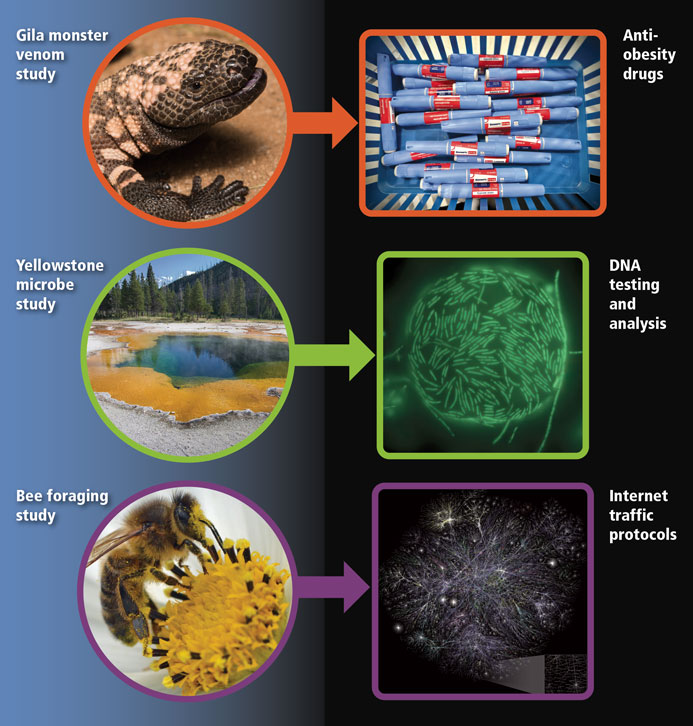
One may be able to recognize good science as it happens, but significant science can only be viewed in the rearview mirror. To pretend otherwise distorts science. DNA restriction enzymes, once the province of obscure microbiological investigation, ultimately enabled the entire recombinant DNA revolution. Measurement of the ratios of heavy and light isotopes of oxygen, once a limited area of geochemistry, eventually allowed the interpretation of prior climate change. What is now promoted as high-impact science is usually a narrow extension of existing experimental designs in a program focused on a set of feasible goals. Fuzzy new directions that might fail, but could open up major new questions, are often dismissed as too speculative and considered low-impact. And in biomedical science, there is an increasing tendency to equate significance to any form of medical relevance. This causes biochemical investigations and research on nonmammalian systems to be treated as intrinsically less valuable than studies on human cells. As a result, biomedicine is losing the historically productive cross-fertilization between model systems and human biology.